Saturday, September 3, 2011

Hood to Coast - The Mother of All Relays!


Last weekend I completed the Hood to Coast Relay (HTC) as a member of the Gresham Fire Do Not Resuscitate team and had a blast! HTC is the largest relay race in the world (more on that later) with 15,000 runners, and travels 200 miles from Timberline Lodge on Mount Hood to the beach at Seaside, Oregon. Teams are made up of 12 peope, split into two vans.

I was waiting for more pics, as I don't have many on my phone, but decided it was time to get the race report out. So I will do an update later with pics when I get them. Rumor is there will be a team video made as well.

This was my first HTC. I did the Portland to Coast walking relay with Mother Superior about 12 years ago, also with Gresham Fire DNR.

I was in Van #1, Runner #2, which gave my legs 2, 14, and 26. We were given a 9:30 AM start time. The weather was perfect, partly cloudy, cool, but forecasted to be a hot weekend. We met in Boring, Oregon (yes, for my non-Pacific NW friends, it really is the name of the town!!) at one of my coworker's homes and decorated our van, got everything loaded, and headed on up the mountain. We are really fortunate to have had another firefighter who has allowed us to use two of his vans from his wife's daycare center for year after year.

Team names and van decorations are one of the highlights of this event! It is a riot to stand at the starting or finish line to hear them announce team names. My favorite? Scrambled Legs and Achin'! One of the most entertaining teams was Timberline Rocks, which included all twelve runners costumed in hair band outfits and wigs (I could not have run in those hair band wigs) and whose vans were decked with loud speakers blasting 80s hard rock, which was very fun but I'm sure incredibly annoying to residents along the 200 mile trek, especially in the middle of the night! They would drive by hanging out van windows, yelling and cheering and whooping it up, singing at the top of their lungs to the music. What a blast!

Some other van decorations that entertained me:


So off we went! The first three legs are straight downhill!

Leg 2: 5.35 miles, 1,500 foot elevation drop, 42:14, 7:54 min/mile pace


Beautiful run, great scenery, very, very, very fast! Straight downhill along the top of the ridge, working hard to keep up with my feet!

Fastest pace of my life! Temperature was still cool but obviously warming up.

Team DNR body art!
While waiting for our fourth runner to come in to the exchange area, we watched a runner from one of the elite teams collapse. It was a horribly frightening thing to watch. He started swerving, jello legs, collapsed, got up, collapsed, got up. Three of us, me, another firefighter from my team and a former department explorer who is an ER tech, ran over when we realized the HTC volunteer near the runner wasn't realizing this was a serious emergency. We had him summon paramedics and worked to cool this runner and keep him from trying to continue and suffer serious medical consequences. We did get his band transferred to the next runner on his team so they could continue. We stayed with him and helped the fire crew evaluate him until our runner arrived. We never did get an update on him, we hope he was transported and is recovering well.

So it was back into the van. The rest of our van's first set of runs went well. It got scorching hot by the time we reached the exchange point in Sandy to meet Van #2, well into the upper 80s/low 90s. We headed back to our hosts' house in Boring to get cleaned up, eat, and rest until we had to head into Portland for to the next exchange point at the base of the Hawthorne Bridge.


Leg 14: 6.09 miles, 1:01:59, 10:10 min/mi pace

I didn't enjoy this leg as much, which surprised me, since it was pancake flat. However, while it was dusk and the temperature had fallen, the humidity had risen to a point where you could not get cooled off and it felt as though it was still in the mid 80s. The runner before me felt very hot during her run.

I donned my headlamp (sexy) and headed out. It's through the industrial area of Portland, not really a pretty area to run and hits Highway 30, under the St. John's Bridge and through Linnton. I hit one pothole in Linnton and would have really twisted my ankle if I had been running at speed, but it occurred at an intersection and I slowed for a car, which saved me.

Back into the van to try to sleep during the other runner's legs, changed my clothes behind an Oregon Trail marker in the dark along Highway 30! We got into St. Helen's for the van exchange at 1:30 AM and headed into St. Helen's High School for showers, food, and a quick nap on the wrestling mats in the gym. I did score a twenty minute session with one of the massage therapists (best $20 I've ever spent!) before my nap and had her work on my legs and feet.

We got up at 4AM and headed into the coast range for our final legs.

Leg 26: 5.77 miles, 0:57:31, 9:49 min/mi pace


This was my absolute favorite run of the three legs! It was 5:30 AM, sun just coming up in the meadows of the coast range, low laying fog on the fields. Just peaceful and cool. I wore my headlamp, but could have passed it off to my van at the halfway point because the sun was up by then, and donned my sleeves Mother Superior had bought me, which were just the perfect amount of coverage with running shorts and tank top for the right body temp.

After my leg...the traffic nightmare started. HTC added 250 teams this year (which equates to 3,000 more people and, more importantly, 500 more vans) so they could retain the title of  "largest relay in the world." However, the two lane roads in the coast range could not handle that increased capacity, and vans got stuck in a traffic jam up to 3 miles long trying to get to the next exchange point to transfer runners. It was a disaster! None of us could remember traffic like this in past years, and DNR has participated in the last 15 years at least. It got to the point where our runners were going to beat our van to the exchange, which required the next runner to get out and run with them, up to 1.5 miles early, to the exchange point. All teams were having to do this. HTC's Facebook page is full of unhappy (even angry) posts from runners and teams. Hopefully they will respond and alleviate this problem next year.

We never saw Van #2 at the exchange...only our last runner did since we were 3 miles back when they met. We picked up our last runner and headed to Seaside, but had a nice stop at some little bar in the coast range with the best Bloody Mary's ever!

And I have to say...my legs were killing me! I never get sore on my runs or tri's anymore, even my long twenty mile runs and now I have to say it is because of my ice baths. Running 5-7 miles and then sitting for 8 hours, running again, sitting for another 8 hours, and running again took a big toll on my legs. Going down stairs and sitting on the toilet were nightmares by the end! Thank goodness I had that massage halfway.

The Finish Line!!


The party at the beach is amazing! Live music, food, beer, thousands of partyin' runners and their friends and families. We waited for our last runner to come in, regrouped and crossed the finish line together for our picture and medals.
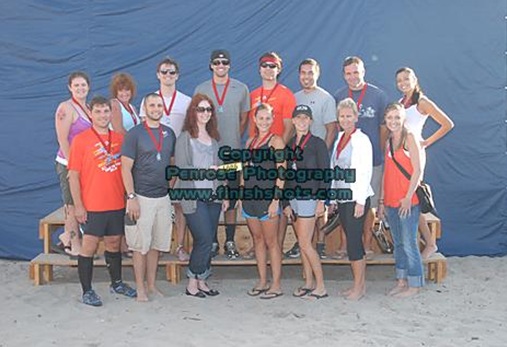
Gresham Fire Do Not Resuscitate 2011


And then the party! Fireworks and live band, best beach party ever!


Hit Machine rockin' the HTC party
 
I will definitely do this event again! So much fun, worth the pain!


Monday, August 22, 2011

Portland Triathlon Race Report

A podium finish!

I completed the 2011 Portland Triathlon Sprint Distance August 21. What a great challenging event! Kudos to Athletes Lounge for organizing a great event. The Portland Triathlon was touted as the "Greenest" race by Triathlete magazine, known for its sustainability, use of recycled products, solar-powered electronics, composting food debris, etc. Check out yesterday's Oregonian article for more: http://www.oregonlive.com/portland/index.ssf/2011/08/participants_in_downtown_portl.html.

Portland Triathlon, August 21, 2011, Waterfront Park, Portland, Oregon - 1:59:36.1
There were a lot of firsts for me at this triathlon. First time doing the Portland Tri, first river open water swim, first sleeveless wetsuit swim, first dock start, first bike over Marquam Hill, first hot weather event, and my first time in Female 40-44 since it was a USAT event and I got "aged-up" into a new group. It was also a longer sprint course, bike was 26k (16.2 miles). Again, as in last report, I will indicate time difference from previous triathlon (Midsummer in this case since the distances are similar), negative (-) time is faster and positive time (+) reflects longer time.

The Swim - 00:17:41.307 - 0.5 miles (-00:01:17)

This was my best swim ever! I felt fantastic the entire time. Upon reaching the dock at the end of the swim I actually had some internal dialogue that I could have easily taken a second lap and completed the Olympic distance--a huge first for me!

This course is a dock start, not a dive off the dock start, but a hold onto the dock, can't touch the bottom, create your own momentum swim start. The water was 69 degrees (F), having had a run of 80-90 degree days for the past couple of weeks. Since the water was so warm and the ambient temperature was in the 60s at 6AM and forecasted to be in the 90s, I opted to go without my tri sleeves for the swim as not to overheat waiting for the event to start and while swimming. It was the right decision. Swim was an out-and-back, with about 25 yard separation between the legs to avoid a past problem of head-on collisions after the turn. A big standing ovation to the person who built wooden ladder platform attached to the dock to exit the swim--they announced who it was but I can't remember--it made for a flawless climb up onto the dock from the water.

Also, note on nutrition. I didn't feel great during the Midsummer Tri swim portion, felt that all my blood was at my stomach processing nutrition rather than at my back, shoulders, and arms. This time I was much more careful with my timing. I had 32 oz. carrot/red cabbage juice and 16 oz. carrot/green bean juice 3.5 hours prior to event and 4 oz. of Energy Pudding (Brendan Brazier recipe which I'll post in an upcoming race nutrition blog) 1.5 hours prior, and had excellent energy, no heaviness in my stomach, and no misdirection of blood this time. Also had 32 oz. coconut water for electrolyte preload the night before, and probably about 8 oz. more along with water prior to the race in the morning. I did start to feel hungry at mile 1.5 of my run, so still need a little more adjusting.

T1 - 00:03:19.358 (-00:00:52)

Wow was I dizzy in T1--this has NEVER happened to me before! I had tremendous energy running up the ramp and hill up to transition, in fact, I was frustrated that it was narrow and single file because I couldn't pass the person in front of me who was going slower than I wanted to go. Funny, in looking at the picture, that person ended up being the 4th place finisher behind me! I could hardly stand on one foot to get my socks and cycling shoes on. At one point I considered going without socks since I was having so much trouble, but had never done that and didn't want to try something new in an event. I absolutely REFUSED to sit down, thinking I'd have trouble getting back up (and there was goose poop everywhere!), but I managed, and had a surprisingly faster T1 time than I figured. Turns out, I didn't kick my legs hard enough in the last few meters of the swim, thus causing the dizzies...lesson learned. Grabbed a quick shot of gel (homemade, again Brendan Brazier recipe from dates, agave nectar, and raw carob powder) but even though it'd sat in the sun, it was still thick and didn't get as much from my gel flask as I wanted.

The Bike - 01:05:49.171 - 16.25 miles (+00:13:04)

This was a challenging bike course. All of my other triathlons have been absolutely flat, this was two laps up over Marquam Hill, 500 foot climb, for a total elevation gain of 1,104 feet. I ran this course in March for the Shamrock Run, which was a hella-challenging run, hoped it would be better on a bike, which it was, but still a challenge. The great thing about having a climb is that you have an awesome descent...and had a 32.7 mph max speed on the course, wheeeeee! Some scary road conditions heading down back toward the waterfront, but otherwise very fun! I also noted that I had enough left in me to have gone for a third lap, which was the Olympic distance...

T2 - 00:01:29.921 (-00:01:21)
Screamed through this transition somehow. No bike gloves. It was getting warm, into the 80s already, and I needed to get going before it got any hotter. And, I thought I had tanked my T1 time and needed to make it up in T2.

The Run - 00:31:16.374 (+00:01:14:00)

It was hot, not much shade on this course. My splits were really pretty good. Second mile was slower, had several ramps to run up as the run went along the East Bank Esplanade which are floating docks on the Willamette River, and we had to climb up to get to the Steel Bridge to cross the river. I ended up walking the first half and running the second half of each of the ramps, slowing my time. They also ran out of water at the second water station at mile 2...argh! All they had was HEED, which is not refreshing to me. I took two sips of HEED, realized it would be a mistake to drink it, and poured the rest over my head. I grabbed water in my hand while running past one of Portland's historic Benson Bubbler drinking fountains for a sip and cool down. I think my time would have been much faster if cooler and I'd had some hydration at mile 2. Also felt hungry at mile 1.5, need some nutrition adjustment for that. I was done by 3.1 miles! My internal talk wasn't about how I could do another lap for an Olympic distance, but how I needed to just keep running to get to the finish line!


Waiting for Results

So I had my Garmin, but had started it while on the dock waiting to start, so knew I had about 5-6 minutes extra time from my official race time. Mother Superior and I hung out, visited with friends and waited for my results to post so we could head home and clean up for the two other social events we had scheduled for the day. It was a challenging course, no Athena division, did it as a training event as I was certain I wouldn't have a competitive time. I wish I could have seen my face when I saw the results--THIRD PLACE! It took my breath away, could not believe it!


A terrific event! Will definitely do this event again and probably will do Olympic distance next year. I have a ton more pictures on Facebook, so take a look at my album there. Mother Superior did an excellent job as a race photographer!

My favorite support team member, Mother Superior!
So training partner, Christine, has announced she is training for Vineman 70.3 in 2012...thinking about throwing my hat into that one now...

So now it's prep for the Hood to Coast Relay next weekend and the Stumptown Sprint Tri the weekend after that. Having a blast! Wish you were here!

Best wishes for a great race and train safe!


Saturday, August 20, 2011

Fire Freaks!


Team "Fire Freaks" after the Pineapple Classic 5K

August is a busy race month, which is great but a little sad because it also means the end of this season is quickly approaching. This month includes two fire department events for me--super fun to combine two separate parts of my life!

Pineapple Classic 5K
August 13 I did the Pineapple Classic 5K with Eric Stevenson, another firefighter from Gresham Fire. This race was a fundraiser for the Leukemia and Lymphoma Society, an organization near and dear to my heart. This race was an obstacle adventure race, which I love. Tam Driscoll, from the City of Gresham, contacted Eric looking for Gresham Firefighters to form a team for a special Firefighters Challenge this event was going to have. We formed a four-person team, but ended up with only Eric and I racing.

The race was terrific! It was held in Canby, Oregon at Pat's Acres, a go-cart racing complex. Weather was perfect, overcast, cool. The event included 16 obstacles, including high wall, low crawl, creek wade, rope net climb, etc., and, required each team to complete carrying a pineapple! Most teams dressed in Hawaiian garb...Eric suggested we do the race in turnouts, so sure, I'm game! Running in turnouts is a lot of work...even with the liners removed and in running shoes. It did, however, get a lot of attention and really encouraged us to run strong since everyone was watching and cheering for the firefighters doing the course in turnouts (we were the only ones, by the way). We completed the event in 34:44, including all those obstacles, which means we ran fast! I was super impressed with our time. And it was super fun and a great fundraiser.

Eric, Tam, and me


I'm laying down the challenge for all my firefighter friends for 2012...come out and beat my time!


Hood to Coast Relay Race

The last weekend in August I will be doing the Hood to Coast Relay as part of Gresham Fire Team DNR (Do not Resuscitate). This will be my first run of the HTC, having done the Portland to Coast Walk Relay with Mother Superior with Team DNR about ten years ago. I am doing Legs 2, 14, and 26. I'm very excited about it.


Other Events
August 21 I will be completing the Portland Triathlon sprint, September 4 will be Stumptown sprint Tri. Look for race reports after each of those.

Train safe!

Wednesday, August 10, 2011

Should I Buy Organic?


It's been a while since I had a vegan post in my blog and since I went camping this week and really have no triathlon-related updates, it seems like a great time to talk nutrition! And yes, I had all-vegan camp food during my recent trip into the wild. This post won't be about vegan camp food (but I will do one soon, I promise) but about organic food, a question that comes up a lot and came up from a fellow camper this week.

What is Organic?

In 1990, Congress passed the Organic Foods Production Act (OFPA) which required the United States Department of Agriculture (USDA) to develop standards on how food is produced, processed, and certified to be called organic. Organic food are those produced by methods free of synthetic pesticides or fertilizers, industrial solvents, chemical food additives, irradiation, antibiotics, or genetic modification, on farms or operations certified by a USDA accredited agents. Farms must show they have been free of prohibited chemicals for at least three years, keep organic food separate from non-organic foods, and submit to periodic site inspections.

Food Labeling
Organic food labeling can be confusing, to say the least. So what do all these labels mean? 

100% Organic
  • Must contain (excluding water and salt) only organically produced ingredients and processing aids.
Organic
  • Must consist of at least 95 percent organically produced ingredients (excluding
    water and salt). Any remaining product ingredients must consist of nonagricultural substances approved on the National List including specifiic non-organically
    produced agricultural products that are not commercially available in organic form.
Ok, those are the only two categories of organic foods that can sport the USDA's Organic seal (shown above as my blog art). But what about all those other labels we see on food?
Made with Organic Ingredients
  • Must contain at least 70 percent organic ingredients and list up to three of the
    organic ingredients or food groups on the principal display panel. These products must contain ingredients that are certified organic, however, the product cannot display the USDA Organic seal anywhere on the package.
What about the other food labels we commonly see...?

Free Range
  • A chicken who was given access to the outside for as little as five minutes a day, not that it actually went, but that there was a single door in the side of the barn big enough for a chicken to get out if it could get to it. No limitations on hormone or antibiotic additives in feed.
Sustainably Harvested
  • Is a marketing gimmick. There is no description or certification or legislation that set parameters on what this means.
Natural
  •  A term regulated only for meats and poultry, contains no artificial flavors, colors, or chemical preservatives. Otherwise meaningless.
Made with Whole Grains
  • Meaningless marketing gimmick. Other than somewhere in the nutritional contents is at least one ingredient that is whole grain, does not have to be the primary ingredient at all.
Non-GMO
  • An important label (in my book) that indicates that no Genetically Modified Organic (GMO) products were used. GMO products are generally soybean, corn, or wheat that were genetically altered as not to be killed by Roundup herbicide spray, thus allowing farmers to liberally spray fields with Roundup to kill weeds while not killing the crop. 

Which fruits and vegetables should you buy organic?
Organically grown fruits and vegetables are admittedly more expensive than their non-organic counterparts. Do you HAVE to buy all organic or are some more important than others? The quick answer, if you're going to eat the peel, then yes, organic is best. If you're not eating the peel, such as an avocado, banana, orange, etc., than you can get by with the non-organic version. However, there is a "dirty dozen" list of fruits and vegetables that you SHOULD buy organic:

Twelve Fruits and Vegetables You Should Buy Organic
  • Nectarines – 97.3% of nectarines sampled were found to contain pesticides.
  • Celery – 94.5% of celery sampled were found to contain pesticides.
  • Pears – 94.4% of pears sampled were found to contain pesticides.
  • Peaches – 93.7% of peaches sampled were found to contain pesticides.
  • Apples – 91% of apples sampled were found to contain pesticides.
  • Cherries – 91% of cherries sampled were found to contain pesticides.
  • Strawberries – 90% of strawberries sampled were found to contain pesticides.
  • Imported Grapes – 86% of imported grapes (i.e. Chile) sampled were found to contain pesticides.
  • Spinach – 83.4% of spinach sampled were found to contain pesticides.
  • Potatoes – 79.3% of potatoes sampled were found to contain pesticides.
  • Bell Peppers – 68% of bell peppers sampled were found to contain pesticides.
  • Red Raspberries – 59% of red raspberries sampled were found to contain pesticides.

The pesticide levels of these 12 fruits and vegetables are low to undetectable; okay to buy conventional: Asparagus, Avocados, Bananas, Broccoli, Cauliflower, Kiwi, Mangoes, Onions, Papaya, Pineapples, Sweet corn, Sweet peas.
I hope this helps! It is confusing, was confusing for me and I have to refer to my list all the time. In general, any fruit or vegetable I am going to use in its entirety (peel and all), especially in juicing, I use organic. I juice lemons whole, so I spend the extra cash for organic lemons, I figure I'm worth it!

Monday, August 1, 2011

Midsummer Triathlon Race Report

First Place medal, Athena 30-39 Division

I got my first medal! What an amazing, fun, crazy thing that was!

Amica Insurance Midsummer Triathlon, July 31, 2011, Blue Lake Park, Fairview, Oregon - 1:49:15
Yes, another triathlon at Blue Lake Park! However, the bike was 16 miles, 4 miles longer than my previous tri there. My times now include difference from previous triathlon personal best. Negative (-) time is faster and positive time (+) reflects longer time.

The Swim - 00:19:24 - 0.5 miles (-00:01:56)


This is the exact swim course as my previous tri at Blue Lake other than starting a little further in the water so no dolphining of the start. Like before, about 200 feet in a bunch of people who started super fast stopped and I had to go around them. After the first turn buoy I noticed the bulk of the swimmers were about 50 feet south of me for some reason, way off the buoy line. Think they were following someone, I continued to do my own sighting. It meant no one to draft off of, but continuing south toward them just to draft didn't make sense. I did pick up someone to draft right after the last turn, so spent the last 250 yards in draft, which was a great way to conserve energy for the bike ahead.

 
T1 - 00:04:11 (+00:00:12)
Due to my recent bout with ulnar neuropathy, I opted to don cycling gloves this time. My increased time reflects my struggle to put gloves on my damp hands! I don't think I will do that ever again on a sprint tri, just seemed unnecessary.


The Bike - 00:52:45 - 16 miles (n/a due to difference distance, 0.6 mph faster than previous)

I didn't realize until about 10 minutes prior to starting the event that the bike was 16 miles instead of 12! Glad I listened to the pre-race briefing! I was anxious for the ride so I could compare with my new HED Jet 4 wheels. I did increase my speed by 0.6 mph from previous.

I rode the majority of the time in my lower drops, keeping my torso low and my hands out of the hoods as not to crush my ulnar nerves. This seemed to work. I did have some brief tingling in my left pointer finger and realized I was mashing my radial nerve and adjusted my hand. Paying more attention to my hands now!

One thing that happened this time was an inefficient turnaround for me. During the race briefing they announced that the turnaround was at the SeaScout base on Marine Drive, just opposite the Port of Portland Fire Station. I am VERY familiar with this area and planned my gearing accordingly. However, I came upon the turn just after a rise about 0.25 miles BEFORE the fire station, totally unprepared for the turn, in high gear. There was no warning sign that the turn was coming up. So my speed suffered after the turn for a while.

T2 - 00:02:52 (+00:00:10)
Those silly gloves again! Probably just should have worn them on the run...

The Run - 00:30:02 (-00:00:19)

I ran more consistently this time, and no shin splint feeling (checked the tongue of my shoe more carefully). I did watch a runner in front of me take a scary tumble about 2 miles in and briefly stopped to check to make sure he was ok, and then watched my feet carefully realizing that the shaded patch was full of areas pushed up by tree roots, which tripped the other runner.


Getting There Early


We arrived at the gate for the park just slightly before they opened at 6 AM and were the third car in (Portland Tri Club friend Darcie Facebooked me that my car was very obviously the third car in due to it's location in the parking area!). But I got some prime real estate! It's really nice to get there early and not feel rushed before the event.

Medaling

My first event medal placement ever! Really quite an amazing feeling. It's not what I do these events for, but it is a very nice extra.


Sherri and me with our First Place medals


Friendly Competition!

Fellow Portland Triathlon Club member Sherrie Austin and I have been "chasing each other" in these two tri's. This year we are in separate divisions, but next year I move into Athena 40-49 and the real fun begins! We had met each other via the PTC Google Group after sharing race reports for the Blue Lake Triathlon, and we met at Midsummer waiting for the medal presentations to start. We both placed first in our respective divisions. I think it's going to be great to have the friendly competition to push me into improving next year!


A special shout out and thanks to my personal support crew, Mother Superior and Trimazing Christine! You make the day even better! Couldn't do it without you!

Check out the new awesome orange and black sleeves from Mother Superior!

Thursday, July 21, 2011

Ulnar Neuropathy

Tools used in Graston® Technique for Ulnar Neuropathy Treatment
If you follow me on Facebook you already know that I lost the use of my ring and pinkie fingers on both hands after the completion of the STP last week. During the last 50 miles of the 200 mile ride, I started having significant problems shifting my front gear, especially into the biggest ring and, in fact, had to reach across with my right hand to shift up much of that time. I had been having problems with my front derailleur prior to the STP, had it repaired, and assumed that my derailleur was once again out of adjustment and therefore difficult to shift. Later in the ride, I also found that I could no longer squeeze my water bottles to drink and had to suck the water from them, and even later, found I could not even grasp the bottles and dropped them at every rest stop when trying to drink. I stopped drinking water while riding due to fear of losing my bottles on the ride. When I got home, my friend who drove me asked if I would play something on the piano and to my shock--I couldn't play, my hands would not work! Shock and dismay! I tried to do an Internet search on the computer to find out what was wrong with my hands but could only type with my thumb and index fingers.

Function was still impaired the next morning and after slowly typing and searching the Internet, I discovered that I had probably developed Ulnar Neuropathy or "Cyclist's Palsy." I contacted Russell Cree of Upper Echelon Fitness who immediately scheduled me to come in the next day for a complete sport's medicine assessment with him and his team to figure out what was going on, wanting to ensure that I did not have a spinal issue as the cause of my neuropathy. He also wanted to do a medical bike fit to see if something had changed from my initial fit he had done in February. I also had a physical exam with my physician who concurred I had a peripheral nerve palsy without any cervical involvement.

Ulnar nerve and its branches, courtesy of http://www.netterimages.com

Russell and his team concurred that I indeed had Ulnar Neuropathy caused by entrapment of the ulnar nerve at Guyon's canal, caused by pressure and vibrations from my grasp and hand position during the STP. Ulnar neuropathy is just like Carpal Tunnel syndrome except that it involves the ulnar nerve on the pinkie side rather than the radial nerve on the thumb side of the hand. The ulnar nerve passes through a tunnel between the pisiform and hamate bones and the pisohamate ligament that join them together. Your hand position on your handlebars can put pressure on the ulnar nerve within Guyon's canal; combined with road vibration, this can cause enough damage to inhibit nerve impulses to travel through this area, thus causing weakness and loss of function to the pinkie and ring fingers.

The good thing about this injury is that it is generally well self-healing with rest. I had chiropractic treatment on my neck, back, shoulders, arms, and hands to eliminate any sources of pressure or entrapment along the entire ulnar nerve, as well as deep tissue sports massage to loosen muscle and other tissue adhesions. The muscles of my forearms were very tight, probably contributing as well to ulnar nerve entrapment. They also suggested ice and stretching. Recovery is expected to be about a couple weeks.

The pad on the pinkie side of my palm (hypothenar eminance) was particularly tender. During my medical bike fit, we determined that during my ride, probably due to fatigue, I had shifted my hands in the hoods of my integrated shift/brake levers so that the hypothenar eminance (shown on the left in red) rested solidly on my handlebars rather than riding in the area between the hypothenar and thenar eminances (should ride in the area delineated in blue). This position most definately contributed to my condition.

To prevent this, I will have to be vigilant about hand position. I also purchased new riding gloves with more padding over Guyon's canal, and will add gel padding under the bar tape on my handlebars to reduce vibration transfer to my hands. It is also important to change hand positions during long rides, taking hands out of the hoods to the top bar during parts of the ride you don't need to be concerned with shifting, braking, or low body position. And furthermore, the dreaded core strengthening....I will need to work on continued core strength so I can hold my torso in the forward riding position without putting so much weight on my hands. Russell raised my handlebars 1cm to relieve hand pressure during my recovery. I will decrease this when fully recovered but remember to raise my handlebar height in the future during long distance rides.

This week I was also seen by an Occupational Therapist who specializes in hands for further assessment and treatment. She went over a whole host of stretches and "nerve glides" to increase my flexibility and free up any catches or constriction on my ulnar nerves. In addition, she referred me for Graston® treatment. Graston® Technique is a procedure used to detect and treat adhesions in muscles and other structures. We all develop adhesions, or scar tissue, as our bodies work to repair themselves. Training causes micro tears in tissue, which leads to more scar tissue. This scar tissue is not flexible nor as strong and actually shrinks and shortens muscle fibers, which can decrease strength and even entrap nerves. Scar tissue also blocks blood flow to tissue, further decreasing strength. During Graston® treatment, the practitioner runs metal instruments along the muscles, tendons, and ligaments and can feel areas of scar tissue, which they can then "break up" with the tools. It is similar to deep tissue massage, but the tools do not yield to scar tissue as a masseuse's hands would, thus Graston® can break up more areas of adhesion. Like deep tissue massage, this procedure can be painful and lead to soreness and even bruising as scar tissue is broken up and blood supply rushes back into the tissues. My session had the same sensation as a deep tissue massage and the skin of my arms got very red and flushed like you'd get from an "Indian rub burn," but when it was done, they felt extremely energized, probably from the increased blood flow. I had some soreness the next couple of days, but no visible bruising. I will have this done once a week for the next few weeks.

Here is a video with more information on Graston® Technique. It shows a treatment for carpal tunnel  syndrome, which, again, is similar to my condition but involves the radial nerve rather than the ulnar nerve.


So my prognosis is great! By Sunday, a week after the condition started, I was significantly improved. I was even able to play the piano, not perfectly, in fact I still had some problem with spatial awareness with my pinkies and decreased stretch, but I did go for a bike ride at the Oregon Coast without any hand issues. I will be continuing weekly deep tissue massage and Graston® treatment, sports chiropractic treatments every other week, stretching, and acupuncture.

Fort Steven's State Park

Due to my hand issues, I opted out of the Girlfriends and Dudes Triathlon so I could rest and and heal before the Midsummer Triathlon July 31st. Girlfriends and Dudes is a charity event, not USAT sanctioned....Midsummer is a USAT event and held at Blue Lake where my last tri with my 2nd place finish time, so I really want to be healed up for it and do well in comparison. So, instead of the tri, I went to the Oregon Coast with my friend Kevin and we rode from Warrenton to Ft. Steven's State Park. 

It was misty and rainy, but a great ride. No hand problems. I did have tire and tube problems, though. During the STP I realized my tires were pretty much shot and prayed and hoped that my tires would hold together for my ride--they did, but that was the end of them. At mile 12.5 of this ride I developed a rear flat (which caused a low-speed crash, but I was fine). I changed the tube, found no sharp objects in my tire, proceeded on and developed another rear flat at mile 12.75. This time I could hear air pouring out of my tire, not just my tube, and found several large holes in the tire. Long story short, we got a ride back to the start by some very nice people and I will be purchasing new tires for OJ this week.

So, I should be back up and training this week. Hope everyone is doing well and talk to you soon!

Thursday, July 14, 2011

Seattle to Portland Ride 2011

Fun with refrigerator magnets at the halfway point

I've crossed something off my Bucket List! As a little girl growing up in Longview, Washington, I would watch for the bicyclists in the Seattle to Portland bike ride to come through town every summer. I remember being at the intersection of Fisher Lane and Westside Highway, waiting for cyclists to pass and telling Mother Superior, "I'm going to do that some day." Well I did, finally! Bucket List pic to the right, taken on West Side Highway, one mile north of that intersection!

The Seattle to Portland Bicycle Classic (STP) is a 204-mile supported ride organized by the Cascade Bicycle Club. It started in 1979 as a race but is now a noncompetitive ride capped at 10,000 participants.

Team Awesome, AKA Dan and the smyelin' babes!
I participated in this event with high school friend, Theresa Heim-Stohler and riding friend, Dan Kalowsky. None of us had done the STP before.

Theresa and I loaded our bikes on my car and headed up to Seattle the night before with Mother Superior. Thanks, Theresa, for the wonderful suggestion on staying in the Seattle area the night before rather than driving up at 2AM! We met Dan at 5AM at the start in the parking lot of the University of Washington. Mom then drove my car back home to my house. Thanks, Mother Superior! We couldn't have done it without you and all your driving!!!

I volunteered as part of the medical support team on this ride. To accommodate the first aid supplies I wanted to carry, I added a rear rack and bag filled with various dressings and bandages, ice packs, Benadryl, Chamois Butter, glucometer and glucose gel, etc. I also wore a special red jersey with a star of life on it to designate I was part of the medical response team. I have to admit, I was so surprised by all the thank you's from other cyclists during the ride when they recognized my jersey--I didn't expect that at all. I would have carried all the first aid supplies anyway, I always do, so it made sense for me to participate officially in that capacity.

Kent REI Rest Stop
We couldn't have asked for more perfect weather. There were broken clouds, cool but not cold, at our 6AM start. They started us off in waves as riders accumulated at the starting line. The route took us past Lake Washington, to the first major stop at the Kent REI. This was the best stop of the whole event, with 70s disco music, a costumed emcee at the entrance, girls carrying trays of food for the riders, etc. We were energized...I danced the whole time we were there!

STP Day 1
 We headed back out on the road toward "The Hill" in Puyallup, a 7% grade one mile climb. At mile 53 we hit Spanaway and pulled into the High School for the midway food stop. Volunteers had free food for us, wraps, fruit, bars, cookies, water, juice, Nuun electrolyte drink, Jamba Juice, etc. We just kept filling the pouches on the back of our riding jerseys then had a little picnic on the football field. The sun was out but it wasn't too warm.

The next half of the trip skirted behind Fort Lewis Army Base, a road with a narrow bike lane and fast traffic. We stayed on this path until Yelm where we hit the Yelm-Tenino Trail for 14.5 miles. It was nice to have a dedicated bicycle trail after miles of fast traffic roadway.

Theresa and Dan enjoying beers!
After a quick stop in Tenino for water and a snack, we finished the last 15 miles into Centralia. We enjoyed a free orangesicle, stashed our bikes in the secure bike corrall for the night (Centralia PD provided security), and headed to the beer garden for a couple cool ones (and pizza). The midpoint stop is held on the Centralia College campus. A lot of folks packed tents (you are allowed to check two bags each that STP transfers from Seattle to Centralia and from Centralia to Portland) and camped on the grass, others threw sleeping bags on the gym floor for the night. We were lucky enough to have one of my high school BFFs, Seriny, who lives in Chehalis, come pick us up and host all three of us for the night. Seriny and Jason, you are both awesome! Thank you for the hospitality, food, drink, comfy beds, and ride from and back to Centralia!

We dropped off our bags, picked up our bikes and hit the road at 6AM for day two with similar weather, perhaps just a shade cooler. We started out ahead of the bulk of the riders so it was nice and sparse, but after stopping to do a medical assist at mile 4.5, we were taken over by a huge crowd of riders. (I'll do a medical assist summary in a bit.) This was a beautiful section of riding, rural, little traffic. We pulled into Lexington, just north of Longview, at mile 144 for the midpoint lunch break. Just as the day before, volunteers had free lunch for us.


Mother Superior noticed prior to the ride that the route was going to pass right in front of the Canterbury Inn where Grandma Janet lives. So we gave a heads-up text to Mom when we left Lexington and stopped to visit Mom Sup and Grandma four miles later. It was so great to stop and visit Grandma and be greeted with cold washcloths for our faces and fresh fruit from Mom! Mom and Grandma had been sitting out front for an hour enjoying watching all the riders pass...they were cheering and clapping for them and the riders waved and hollered back and rang their bicycle bells as they went past.

From there we hit the Rainier Bridge to take us over the Columbia River into Oregon. The Goldwing Touring Association escorted us over the bridge in big groups, shutting southbound traffic occasionally to let us have the roadway to ourselves. The bridge wasn't nearly as difficult as I had psyched myself into...in fact, pretty easy (but hey, thanks to Dan's Skyline Blvd. tour the week before, EVERY hill was easy!)

Waiting at Rainier Bridge
So we followed Highway 30 all the way into Portland from here. Notably, the worst part of the ride, trafficwise. Highway 30 is horrible in a car, let alone on a bike, as it's narrow, curvy, and fast traffic. We fortunately missed a patch of tacks in the bicycle lane (http://www.oregonlive.com/news/index.ssf/2011/07/post_121.html) between Scappose and Cornelius Pass. Right at Sauvie's Island, at a crest in the road, we got our first glimpse of Portland in the form of the spires of the St. John's Bridge spanning the Willamette River! Woooooo Hooooo! We exited Highway 30 to the NW Bridge Avenue hill approach to the St. John's Bridge, wound through North Portland and along the bluff, and finally crossed the finish line at mile 204 at Holladay Park by Lloyd Center Mall!


That's us...Dan, Theresa, and me, approaching the Finish Line!
A terrific event! So well organized! I would do it again in a heartbeat and encourage all my riding friends to do the same!

I had seven total medical assist stops on the route; two the first day and five the second. Most were sore knees, scrapes from minor falls. I did treat two bee stings to the lips, fortunately no allergic reaction component to either. The most significant injury was a broken clavicle sustained during a low-speed collision and crash at the Winlock food stop. Will definitely do medical support in the future and have a list of things to include next time...like waaaaaay more ace bandages!

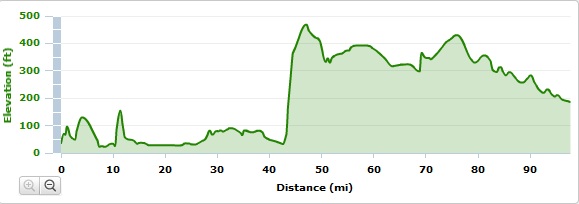
Elevation Profiles
Day 1

Day 2
 So until next time...Ride Safe!